Sunday, October 8, 2017

Onwards to Mount Isa

By Jen.

After our excursion through outback NSW, we entered Queensland (QLD). This is our last new-to-us state in our Australian journey. We have officially been in every state in Australia now! The plan was to travel north and west up to Mount Isa and then swing back east to Cairns. From Cairns, we would begin our final southward journey back to Melbourne via the notorious East Coast of Australia.

DSCN5874

DSCN5876

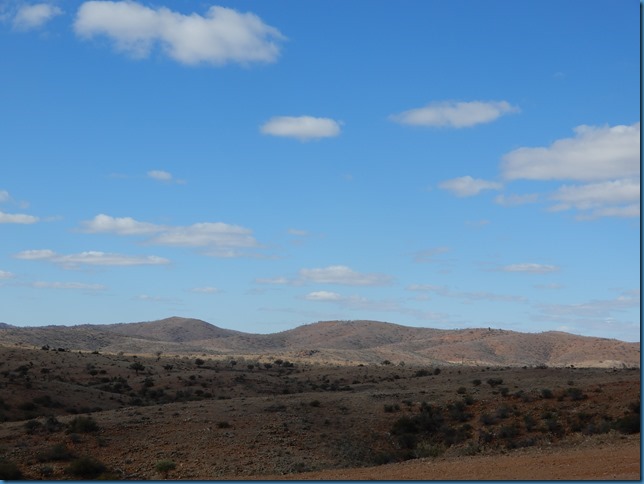
Like the rest of Australia, Outback QLD consists of long stretches of flat, arid country, interspersed with small towns with random knick-knacks and claims to fame.

DSCN5878
Statue of “The Cunnamulla Fella” in the town of Cunnamulla.

DSCN5890
In 2014, a truck carrying anhydrous ammonia caught fire and then exploded, wiping out the bridge for cars and the nearby railway. We had been in a town further south and thought the railway only looked recently abandoned (only long enough for a small sapling to take root. Now we knew why.

DSCN5893
You remember back in school when they told you about people trying to make it rain by sending stuff up into the sky? A scientist actually did the experiment in Charleville to endeavor to end the drought! Of course, it didn’t work, but it was interesting to see these Stiger Vortex Cannons on display there in the middle of their disc-golf course.

(insert photo)


 They also had a Bilby conservation center there. We arrived on National Bilby Day and got to see them in the dark room! They are interesting creatures. Kinda the marsupial version of the rabbit. But they are greatly endangered, with only about 400-600 left in small pockets in the wild. 


DSCN5908
Barcaldine was the headquarters of the major sheepshearers’ strike in 1891, where meetings were conducted under the tree of knowledge. In 2006, the ancient tree was poisoned and died. Instead, they now have a unique memorial around it.

DSCN5907
The empty space around the tree represents where its canopy used to be in its glory days.
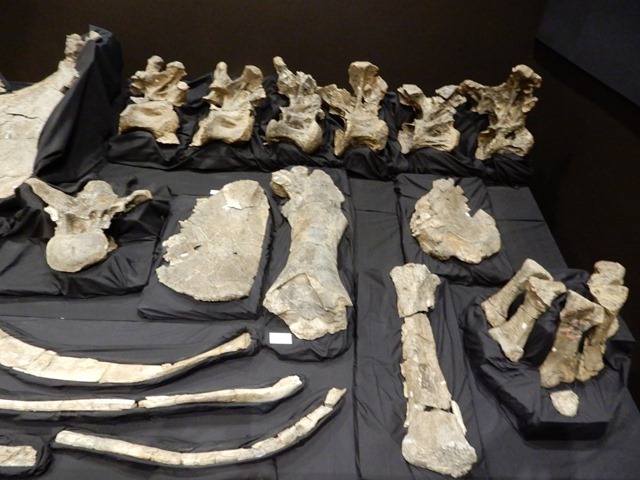
DSCN5913
In Winton, there was a research museum called Australian Age of Dinosaurs with sauropod fossils. They were massive!

For those Despicable Me! fans out there!

On the fifth day after entering QLD, we finally arrived in Mount Isa, in time to restock before we continued on.

DSCN5930
The smoke stacks from their mining operations are huge!

DSCN5931
Long way from anywhere.

Thursday, October 5, 2017

Central NSW

On our drive north from Victoria we took a meandering route through the center of New South Wales (NSW).  Referred to as NSW’s outback, this arid region will probably remind you of NT and WA.
Our first major stop was Mungo NP.  This park, once a large pastoral lease, is now a NP due to its unique archeological significance.  The park centers on a now-dry lakebed surrounded on the east by tall multilayered dunes.   In the photo below, you see the expanse of the lakebed, and the dunes on the far side. 

 DSCN5817

What makes this park unique is the archeological finds in the dunes themselves.  This area has been occupied by aboriginal peoples for over 40,000 years. The dunes build and erode at very predictable rates based on whether the lake is dry or not.  This has allowed very precise dating of the various remains found here.  Everything from bones to ancient fire pits.

Despite getting less than 12” or rain a year, there is plenty of life here. 

Some Pink Cockatoos.
 DSCN5841

A hawk sitting on the highest thing for miles.
DSCN5814

When the vegetation is disturbed, erosion begins.  Here you can see the alternating sand and silt layers that were deposited over the last 100 thousand years during alternating wet and dry periods.
DSCN5827

A red kangaroo doing what they do best.
DSCN5829

Even in the desert, there is water if you know where to look.  At this soak, water in the dunes pools just below the sand.  Animals come from miles around during the dry to get a drink.  Here you can see a flock of emus digging holes and getting a drink.
DSCN5833
DSCN5837
DSCN5835

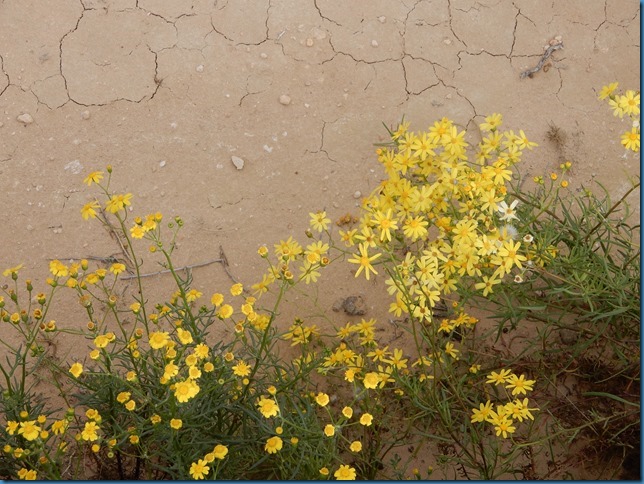
When rain does fall, grasses and wildflowers spring up from the seemingly barren earth.
DSCN5834
DSCN5819

Continuing on, we visited Broken Hill and the hilltop sculpture installation west of town.
DSCN5848
DSCN5845
DSCN5842

We got to watch the sun set from the edge of nowhere. Flat enough that you can see the curvature of the earth almost.
DSCN5854
DSCN5851

This is mining country, and the next town, Cobar, is no exception.
DSCN5857

You can see a pickup truck at the bottom, it pretty small at this distance.
DSCN5856

We rounded outback NSW off with some ancient rock art in Gundabooka NP.
DSCN5870DSCN5863DSCN5869

Tuesday, October 3, 2017

On the Road Again

By Jen.

Finally, with our van serviced and our storage spaces overflowing, we were ready to hit the road again. The goal was to get back north again and carry off where we left off after Alice Springs to complete our clockwise circuit of the country. Since there isn’t much between Alice Springs in NT and Mount Isa in QLD, we decided to head pretty much north to Mount Isa via various inland routes, knocking off most of the rest of the outback items along the way. Therefore, we left Melbourne to head for Broken Hill, NSW. Of course, if you know me, we wouldn’t be making a beeline straight there, we would wander around and see some sights along the way.

DSCN5746
A family of kookaburras kept us company while we were working on the van.

First off was the Daffodil Festival in Kyneton! There weren’t actually that many activities involving daffodils, sadly, but they did have a long row of them at the entrance to town. And, they had ferret races!

DSCN5749

image for ferret races.

As we drove further north, I discovered a new favorite industrial cash crop: canola! The fields of flowers are gorgeous!

DSCN5766


DSCN5768


Since we visited Little Desert National Park, I only thought it appropriate to visit Big Desert (Wyperfeld National Park) as well.

DSCN5776
A mob of Western Red Kangaroos.

DSCN5777
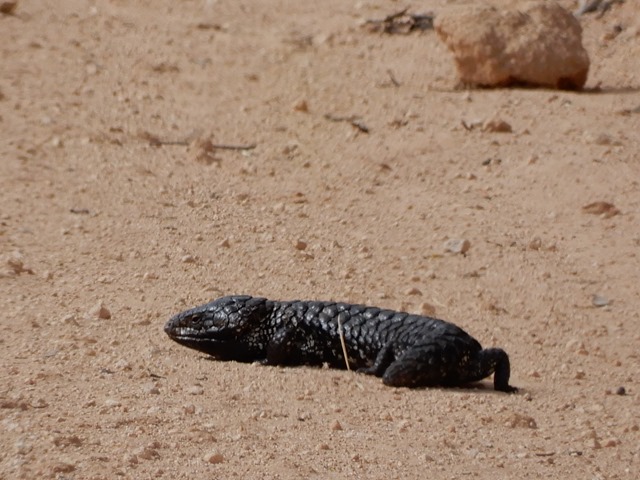
Shingleback Lizard. He was a chunky guy with an attitude. He stuck out his blue tongue at us as we came close (too slow with the camera).

DSCN5780
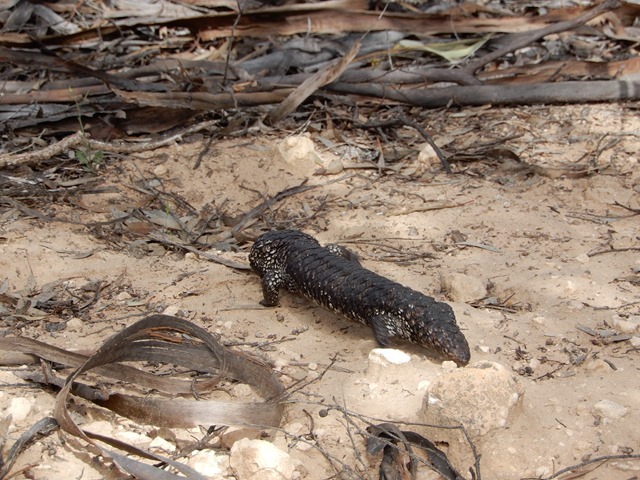
From another angle. He had been chilling on the road (perhaps trying to get thinner?).

DSCN5784
Snowdrift Dune. A large non-stabilized dune with nearly snow-white sand.


From there, it was a visit to the Pink Lakes in Murray-Sunset National Park.

DSCN5790
These lakes are, of course, salt lakes.

DSCN5792
Rather than being pink from pink salt, though; it is the result of an algae. It had been raining recently, which meant plenty of nourishment for the algae, and thus plenty of pink.

DSCN5799
The salt in these lakes is 99% pure, which meant it used to be mined. Apparently the conditions were pretty terrible, though, as they had to do it when the lake was dry in the extreme summer heat.

Then to Hattah-Kulkyne National Park before finally exiting Victoria for the third time.

DSCN5801
This park is home to several wetlands along the Murray River.

DSCN5813
Crossing the Murray River into New South Wales.